Showing posts with label blue oyster gallery. Show all posts
Tuesday, August 18
a tragic delusion
I wrote about the two Wellington artists' works Blue Oyster show A Tragic Delusion for the new(ish) Adam Art Gallery blog called Up and Adam. If you're interested, you can check it out here.
xx
Lou
Tuesday, July 29
'te ao huri huri / the turning world' exhibition text
![]() |
| Photo from Blue Oyster's Facebook |
-
“Moving in or through a given place, the body imports its own emplaced past into its present experience... Orientation in place ... cannot be continually effected de novo but arises within the ever-lengthening shadow of our bodily past.”
Edward Casey, Phenomenology of Memory
As a recent graduate of the Dunedin School of Art, Becky Cameron’s ‘Te Ao Huri Huri | The Turning World’ explores ideas about landscape, belonging and home. Although Cameron only began working with these themes while developing her practice during her honours year, their relevance and significance in her life is deeply rooted. Settled far from her original home in England, Cameron’s work examines her own familiarisation with—and interpretation of— the new, as well as the reinterpretation of the old within different contexts. In this way, Cameron’s work also provides another perspective on what local Dunedin residents may naturally view as ‘familiar.’
‘Te Ao Huri Huri | The Turning World’ represents an intersection between Cameron’s own evocations of memory and the past, as well as those that exist in the wider context of Puaka Matariki. The kinetic light pieces featured in the exhibition are made from an eclectic range of found materials. Once the lanterns are turned on, light moves from the bulbs through hand cut holes in sheets of black builder’s paper. The holes’ shapes are based on shadows of trees and plants that Cameron has drawn or photographed. Quickly after the lanterns are switched on, heat omitted from the bulbs rises through a sliced aluminum-can causing them to rotate slowly—emulating a rich glow that in turn creates a dance of stretched patterns across the floor and walls of the Athenaeum. The paper screens that hang from the ceiling of the Athenaeum are used to reveal different aspects of the work. Catching the light as the lanterns move, the screens bring patterns into focus, providing an analogy for conscious memory. However, the screens also conceal the lanterns, which alludes to the largely unconscious workings of the mind.
These patterns of light symbolise stars in the sky, moving and changing to create sky maps through light. “As the lanterns turn,” Cameron explained, “the design comes in and out of focus, serving as a visual analogy for how memories of place are built up through repeated paths taken through a landscape.” The patterns also interact with the dark, enigmatic textures of the Athenaeum teasing and questioning the history of the very place the viewer stands.
It is the experience of viewing these lanterns together in the Athenaeum that provides the viewer with a literal and metaphorical pathway, moving between Cameron’s own unfolding practice and her explorations into the wider context of Puaka Matariki. As the viewer is guided through the darkness of the Athenaeum, light from Cameron’s works beckons, moving, turning, slowly swirling throughout the vast corridor of space. Following the call, the viewer moves past the first lantern and becomes immersed in the changing stories of the cosmos—the cycles of life and death—the atua Rangi and Papa. “The journey through the artwork is an allegory for the journey of life with its cycles of loss and growth,” stated Cameron. In this journey, the viewer is invited to move down the vaguely spiralled pathway, which references the tradition of the labyrinth as a contemplative device, towards a centre point. When this is reached, the viewer then moves out again, affording time for reflection on the year that has been and the year to come. Thus, as the text scrawled across Cameron’s studio wall reads, in experiencing and interacting with these kinetic light pieces the “the inner seasonality of being human” is brought into question.
‘Te Ao Huri Huri | The Turning World’ represents the aesthetic qualities of Matariki—a cluster of blue, luminous stars, which have formed within the last 100 million years and are a part of the larger Taurus constellation. Looking into the night sky, Matariki—after disappearing for two months—reappears in late May or early June low on the north-eastern horizon of the southern hemisphere. Although there are differences regarding the timing for celebrating Matariki, festivities most often begin at the next new moon after Matariki has risen. “Matariki is associated with the time of the midwinter solstice, the darkest time of the year—but also the turning point when the days begin to lengthen again,” Cameron explained. “The turning of the lanterns with their patterns of light and dark reflect the turning of the world as it goes through the daily cycle of day and night, as well as the larger annual cycle of the seasons.”
While the Matariki star cluster is part of an array of histories for cultures around the world—including its use for navigation particularly by the ancestors of Māori when they migrated across the Pacific Ocean to Aotearoa, the discourse most significant to this display is that of Puaka Matariki.
Although Māori have never been homogeneous in their approach to the New Year (which is symbolised by the reappearance of Matariki), generally, Matariki was observed as a sign to harvest, remember the dead and celebrate new life since the cluster last appeared. As Māori education and development advocate Hohaia Collier writes for the journal Indigenous Voices Indigenous Symbols Māori “did not have a written language by which they preserved their historical narratives. What they did have was a gift of observation that allowed them to establish and build an empirical foundation of knowledge based on the activity of natural phenomena.” It was the signs or symbols within nature, like that of Matariki, that provided guidance on what Māori could do, as Collier noted, the appearance of significant astral bodies was observed as being “coincident with tidal flows, the flowering of certain trees and the appearance of game birds.” Māori astronomy was therefore focussed on astral bodies “as symbols of survival, of guides to us that allowed us to regulate those activities that ensured our survival. The symbolic appearance of Matariki then was to foretell the nature of the coming season and to determine and regulate the cycle of food gathering.”
The first sighting of Matariki was acknowledged by a tohunga (priest) with karakia (incantations) to celebrate the new year. If the star cluster was clear and easily visible straight after the first new moon of June, it was a sign that there would be good crops to follow; however if only six or seven stars were seen the following year was predicted to yield poor harvesting. Matariki therefore became a time to reflect on past seasons and plan for the new one—preparing and mending the necessary tools to do so. Celebrations occurred at the end of this harvesting. During this time pākau (kites) were often flown in an attempt to get close to the stars.
For Cameron, growing up in England meant that Christmas was the big winter festival but even so, Cameron has found links between Matariki and Christmas. “Many of the traditions around that time in the Christian tradition are actually adapted from earlier traditions—ones that were much more closely linked to the natural world through cycles of death and growth. For example the holly and ivy and evergreen trees reflect a pagan festival celebrating the continuing life of the natural world even when it seemed at its lowest and darkest point. The Celts also used the rising of Matariki as a season marker. These pagan connections were repressed by Christianity, and the festivities of Christmas (and Easter) are also dislocated from their original seasonal significance when transposed to the Southern hemisphere.” These festivities and histories that Cameron described add further depth to the themes found or suggested within Cameron’s own work.
In the 21st century, observing Matariki has become popular again. In this way, it is surprisingly fitting that the very space Cameron’s work is displayed in the Athenaeum, which has (until recently) been left unused for approximately 40 years. This awareness and revitalisation of the past in both ritual and physical respects is part of a process that helps viewers to be more conscious of their own cultural identities. “I feel it is vitally important to have celebrations that link into the natural world, and I’m really excited by the revival of Matariki,” Cameron stated. “I’m interested deepening my own connections to the natural world around me through this experience during Matariki.” Immersed in the melodic dances of light in ‘‘Te Ao Huri Huri | The Turning World’ participates in a national interest to give these ideas and traditions momentum.
Monday, March 31
touch paste contact
![]() |
| 'Touch Paste Contact' by Samin Son at Blue Oyster Art Project Space, 25 March 2014. Photo from the Blue Oyster Facebook. |
Immediately I didn't want to be in that room. I thought about my own bedroom, the privileged comfort of a warm light and my carefully curated possessions. As Samin confronted individual members of the audience (resulting in a mixture of uncomfortable feet shuffling, awkward eye contact, and defensive body language) I wanted to be home. I did not want to be subject to or connect with the relentless trauma Samin had obviously experience and was now performing. I also hated the way I was thinking about how others would view my reactions (fear, anxiety) to the performance and judge me. My entire body broke out into a sweat. And yet, I didn't leave. Attempting to do so would have involved inserting myself within the performance even further and, more importantly, it would have involved caving into a weakness that reveals itself to most humans in a situation of emotional confrontation. This was something Samin had to experience and, now, I did too.
After facing each audience member, Samin placed his bucket onto the floor, and proceeded to weave a blue cleaning cloth round the audience, tying one end to a ladder set up beside the gallery's window and the other end around a man's leg. By physically connecting with individuals (and making the physical connection a permanent fixture of the performance) Samin disrupted any notion of a passive audience. We were "there" with him, but - as even Samin asked us - where was "there"? Was it the space of the gallery? Was it a nightmare? Or were we all lost somewhere within Samin's own trauma associated with the past (and his experience of two years as a South Korean soldier)?
At another point during his performance, Samin pulled toothpaste from packages labelled with the word "AIM" (my friend pointed out that this word rearranged also could be "I AM" - a subtle question of identity, creating another question, another layer within the mesmerising performance). Each time the toothpaste was extracted from its package, Samin emptied the contents into a bucket of water. Once all of the toothpaste tubes were emptied into the water, Samin used the concoction in two different, but equally striking ways. First, he dunked his entire head into it, in a shocking infliction of self-harm. Almost temporary blinded by this action, he then poured the concoction over the gallery's front window. From the ladder, he demanded audience members to participate - to aid him in further blurring the window - an act not about the end result, but simply focused on process, like training for indeterminable combat. The atmosphere was tense as people either worried about being singled out or questioned their own involvement in the performance and what it meant to step forward.
During these actions, Samin (despite the physicality of his work) maintained a running monologue - or narration. He described what he was doing, lingering on words and repeating questions. He sometimes chanted, and sporadically challenged the audience. His purposeful breaks of character sent awkward, tittering laughter throughout the audience, his sudden swings back to a cold soldier panicked us, then his sad, forlorn songs filled us with pain. Was he testing us? Was he showing us his own issues of association and identity? Did we fulfill his expectations? Were we failures? Nothing was certain, nothing was clarified.
When Samin ended the performance - with a voice made so raw by the toothpaste that it was almost inaudible - there was a unshakable feeling of awe and shock permeating throughout the room. I felt it so strongly that when passers by laughed at the strange, messy display inside the gallery, I felt a sense of distance and disconnect with the outside world. I wondered if this was how Samin felt and how he wanted us to feel too.
Although I am inexperienced with performance art, Samin filled me with a strange sense of grief evoked by a past that I had not experienced, but knew other humans had endured. Almost a week later, I am still both troubled by his performance and filled with admiration for his art.
Be sure to attend his next performance Orira (to be performed at Blue Oyster Gallery, 6 pm Thursday 3 April). Also, for another reaction piece to 'Touch Paste Contact', you can read Zane's experience of it here.
xx
Lou
Friday, August 3
sue novell - art on campus
Thursday, September 22
a perfect week of art
When assignments wear you down what is a better distraction than Art Week? This week OUSA organised art related events all week which have been wonderful (and free) to be apart of. From badge making, installations and tye die during the day to events every night, it has been lovely. Particular highlights for me included the writer and artist speed date on Tuesday and the gallery crawl around Dunedin on Wednesday night. I have meet so many artists this week and feel like I will continue to see them around and become closer in a professional and friendly way. I am pretty excited about the work of one artist I met and hopefully will be able to write for her sometime. Above are a few photos from the gallery crawl a.k.a 'White Night'. The top photo is of Glue Gallery which is SO up my alley. Like Frankie Mag. cuteness? LOVE this place. The next and last photo is Blue Oyster. The third photo is Rice and Beans which is in a wonderful building filled with artist studios, a gay sauna and seemingly lots of cardboard!
P.S. I met an AWESOME poet this week called David Merritt. I bought his hand made poetry books in a collection of 4 for my Dad's birthday. Both my Dad and David are fabulous, fabulous people.
xx
Lou
Thursday, April 28
Loulou and Nina's Assignments
Last night I went the first (of hopefully many) writers' meetings at Blue Oyster Gallery. The focus for the group is writing about art and it's kind of like a workshop/social/networking environment. In the next meeting we have to bring a piece about an exhibition that we've been to recently and the two more mature members will break it apart as this is the only way we can develop. I want to become a fantastic writer and if I can't, then I will focus on other things. Hehe. A good friend of Mum's (and my friend also) Gabrielle Mckone emailed me saying I MUST look at Nina Katchadourian's 'Seat Assignment' at Dunedin Public Art Gallery. I loved it and alas it also became the exhibition for which I wrote my first art-writing piece! I'll post it on here but don't worry, this blog is not going to become Lou's 'developing as a writer place'...well...only occasionally it will be that. Hehe!
I imagine Nina Katchadourian sitting buckled up to an airplane seat. She pulls from the pouch attached to the seat in front, a magazine. Flicks through, rolls her eyes at the idyllic advertisements, then places it back. She gazes at the blue sky and the clouds below. Slowly she studies the silence of the exterior high atmosphere world, then the thick plastic window, then her seat buckle, in-flight magazine and the overweight business man overflowing in the seat next to her. Through her itching for innovation Katchadourian formulates an idea for a project. The passengers around her don’t physically witness her change from plane catcher to artist but internally colour pours through her mind as she visualizes a map for her artistic challenge.
Over many flights a collection of historical art genres: still life, portrait and landscape are subverted to be incorporated in an airplane environment. Peanuts, black fluff, sun glare, tic tacs, all become part of pre-taken images and thus reconstruct them with a flavor of irony and playfulness which takes away the permanency of the initial ‘finished product’s’ meaning. In Katchadourian’s eyes an image in a magazine is a potential world to which she can build on, subvert, destroy and enjoy. Those very faraway photos of beaches and native forests become new, fresh as we are placed as the flight goer enjoying the discovery of an originally deemed ‘solid’ piece that is now fluid for manipulation and addition or subtraction.
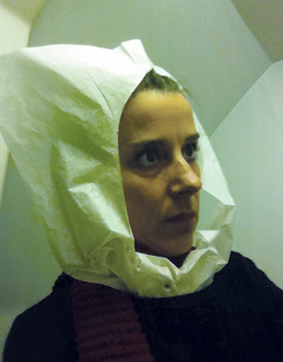
If we walk down the corridor of framed photos we’ll find a more contemporary media being used by Katchadourian to once again elaborate on the mundanity of airplane items to rediscover them and take away our thoughts on the anxiety of flying. Katchadourian films herself in an airplane cubicle wearing different napkins to create Flemish characters whose eyes stare and blink, stare and blink - holding their identity in silence. The absurdity is blended into Katchadourian’s acted seriousness to create several brilliant moments. Do we laugh or will her perpetual gaze forbid it? She may be wearing napkins but suddenly these napkins are symbolic of another culture. Katchadourian teases us once again with her manipulation of the everyday objects that exist on a vehicle 3000 ft above the ground.
In another piece which is around the corner from these filmed projects are photos which show reflections in belt buckles of unsuspecting and often overweight passengers. Katchardourian’s world leaks into reality by incorporating the ‘others’ into it. They do not realise it, but their image is reflected off many different surfaces so while the simultaneously exist in a reality they also exist as an image through which Katchadourian can tease, re-capture, interpret. She is reflecting the image of the society of plane-goers in their purist and most unsuspecting form.
The flying environment is one of claustrophobia, anxiety and boredom, yet Katchadourian challenges this world almost like an explorer with only a few pieces of vital equipment. The permanently mundane becomes a playful studio that embraces the innovation of the artist.
xx
Lou
Nina Katchadourian's Seat Assignment (now at the Dunedin Public Art Gallery)
Over many flights a collection of historical art genres: still life, portrait and landscape are subverted to be incorporated in an airplane environment. Peanuts, black fluff, sun glare, tic tacs, all become part of pre-taken images and thus reconstruct them with a flavor of irony and playfulness which takes away the permanency of the initial ‘finished product’s’ meaning. In Katchadourian’s eyes an image in a magazine is a potential world to which she can build on, subvert, destroy and enjoy. Those very faraway photos of beaches and native forests become new, fresh as we are placed as the flight goer enjoying the discovery of an originally deemed ‘solid’ piece that is now fluid for manipulation and addition or subtraction.
If we walk down the corridor of framed photos we’ll find a more contemporary media being used by Katchadourian to once again elaborate on the mundanity of airplane items to rediscover them and take away our thoughts on the anxiety of flying. Katchadourian films herself in an airplane cubicle wearing different napkins to create Flemish characters whose eyes stare and blink, stare and blink - holding their identity in silence. The absurdity is blended into Katchadourian’s acted seriousness to create several brilliant moments. Do we laugh or will her perpetual gaze forbid it? She may be wearing napkins but suddenly these napkins are symbolic of another culture. Katchadourian teases us once again with her manipulation of the everyday objects that exist on a vehicle 3000 ft above the ground.
In another piece which is around the corner from these filmed projects are photos which show reflections in belt buckles of unsuspecting and often overweight passengers. Katchardourian’s world leaks into reality by incorporating the ‘others’ into it. They do not realise it, but their image is reflected off many different surfaces so while the simultaneously exist in a reality they also exist as an image through which Katchadourian can tease, re-capture, interpret. She is reflecting the image of the society of plane-goers in their purist and most unsuspecting form.
The flying environment is one of claustrophobia, anxiety and boredom, yet Katchadourian challenges this world almost like an explorer with only a few pieces of vital equipment. The permanently mundane becomes a playful studio that embraces the innovation of the artist.
xx
Lou
Subscribe to:
Posts (Atom)