Showing posts with label china. Show all posts

Sunday, May 24

beijing musings


Colin rolled his shirt sleeve up to reveal a barb-wired swastika with “Sons of Badness” tattooed into his skin. He grinned as he studied his arm. He didn’t know what that tattoo’s World War Two implications were, but, for Colin, this swastika was an appropriated symbol from the West (despite its Eastern origins), so it had to be cool. As he began to show us his other tattoos, two toxic green cocktails were placed on the table in front of us. The waiter winked at us, then handed a beer to Colin. Colin fanned out a wad of 100 yuan notes on the table then handed one to the waiter. He lit another cigarette and continued to describe important lessons of love he had learned through How I Met Your Mother. 
Colin suddenly stopped talking and pulled out his cellphone to show us photos of his pet turtle at every angle (here’s one of its leg, here’s its mouth, here it is front on). The turtle’s eyes bulged, illuminated by the phone’s flash. We nodded along, half lost on his broken English. The only time he stopped talking was when he went to the toilet. My friend and I looked at each other, wondering why we were doing this again. We devised a plan to politely thank him for the drinks (untouched after an initial and reluctant sip) and leave. I never saw Colin again, but for months after he sent me messages on WeChat asking me what I was up to and whether I liked Katy Perry’s “Dark Horse”. I didn’t have the heart to either reply to him or delete him. 
Bizarre — the whole thing was. Every day in China’s capital, I experienced things that induced breathless, bewildered laughter in me, or deeply confused silence. My reactions or experiences weren’t particularly unique when compared to those of other foreigners living in Beijing (white-girl/boy-in-China blogs have become a cliché), but — as another exchange student observed over a goodbye meal — those who have lived in China become part of an unspoken cult. They are bonded by their experiences of the unexplained and the bizarre. Within this cult is a further divide: the people who become addicted to life in China and the people who never want to return.
The acceptance of contradictions in daily life by Beijingers is both admirable and nearly impossible to comprehend. But to have a life within this giant ball of tightly interwoven complications, it is inevitable that its people embrace or ignore these complications if they want to keep on surviving. China has achieved the world’s firsts over and over (the compass, paper, printing, gunpowder), sometimes hundreds of years before the Western world stumbled across these innovations. And yet fear of Beijing’s tumultuous, not-so-distant past (including the Great Chinese Famine from 1958 to 1961 as a result of Mao’s Great Leap Forward, the Tiananmen Square protests of 1976 and so on) means open political debate or “alternative” opinions are still subject to censorship. Even while I was there, the 2014 protests in Hong Kong, often referred to as the Umbrella Revolution, meant Instagram was blocked in China with no warning. Beijing’s desire for progress also dramatically changes the cityscape every day. And, in all the spaces in between, there are people — everywhere, doing absolutely everything. This context, paired with exposure to a sprawling population, means there is a statistical certainty of encountering the weird...daily. 
While on exchange in China, I attended Tsinghua University. Along with Peking University, Tsinghua is the top university in China. Its international connections only strengthen its status — Apple’s CEO, Tim Cook, Facebook’s Mark Zuckerberg (strangely enough, considering Facebook is blocked throughout China) and former Wal-mart CEO, H. Lee Scott, are all on the advisory board of Tsinghua’s School of Economics and Management. In practically all respects (apart from the technicality of being a foreigner), I did not deserve to be there. Tsinghua and Peking together take approximately 84 students out of every 10,000 in Beijing who sit the gao kao (basically an incredibly stressful university entrance exam) each year. In places where there is a (controversially) smaller quota, only about three out of every 10,000 are accepted each year. Wrapping my head around these figures and the impossible study students had committed to their entire lives to attend Tsinghua lurched me into a pre-quarter-life existential crisis. Were all my achievements mere ploys? Had I ever tried hard at anything?
Dispersed among Tsinghua’s students — who were already god-like in my eyes — were those that even the Chinese students deemed mythical. Hopelessly inadequate, I almost didn’t want to know. But conversations over hot-pot dinners with friends crammed into our dormitory floor’s kitchen often ventured into these topics. There were the sons and daughters of high-ranking government officials who kept their identities hidden and were evasive when it came to making friends. There were the known, frequently discussed gao fu shuai (tall, rich and handsome) boys and the bai fu mei (white, rich and beautiful) girls. And there were the celebrities, including the “Milk Tea Girl” — a girl who became famous in China for her “purity” and “sweetness” after a photo of her as a school girl drinking milk tea was put online. On a campus where most undergraduates and postgraduates lived, often in cramped living quarters by New Zealand standards, there was a sense of community and, along with that, a culture of constant story telling. 
But, despite Tsinghua’s prestige as an institution filled with impressive individuals, it was not without its oddities. Several nights when returning late to Tsinghua’s campus, I biked past an eclectic pack of stray or abandoned dogs roaming the street. They were determined and in pack formation, so they ignored me and continued on down the road. Another time, around midnight, I had forgotten where I had left my bike. I was briskly undertaking the thirty minute walk from the North East Gate to my dormitory. Again, campus was deserted, but as I turned a corner, out of nowhere, a group of students erratically skated by. They seemed to have been teaching themselves to rollerblade on a long, barely lit road that intersected several large lecture buildings. On a different day, I went to collect my bike and became distracted when a large nut hit me squarely on the head. I looked up. Perched high up in the trees that lined the bike stands were the tiny old ladies who cleaned our dormitory. The strange encounters on campus reached a sickly turn when one morning, as students from my building headed down the small driveway to the intersecting campus street, each swerved to avoid a large puddle of blood, yet to be cleaned up. I momentarily observed the sad, solitary tissue drowned in the middle. 
I knew there would be no explanation, no notice of what had happened, no email out to all the students. By then, China had started to affect the way I thought about and interacted with life. I was one in an expanding city of about 21.5 million people. Actually I wasn’t “one”; I was no one. Apart from being the subject of constant stares as a foreigner, I was still nobody among a huge, constantly moving crowd. Not only did that mean making fast decisions and constantly moving forward, it also meant that when I was out and about, I was out for myself. Fondling on the subway, or getting off the train at peak times, were the small, troubling interactions that I always worried about. Authority or even a kind stranger to help you were rarities, not givens. It was exhilarating. 
It is a mess of terror and thrill when you sit in the back of a taxi (seatbelts, of course, ripped out) racing and swerving through traffic, anticipating a night roaming from bar to music venue in the fast-disappearing hu tong (traditional, alleyway neighbourhoods) of Beijing. The taxi would pierce through the heavy veil of air pollution that, on several days while I lived there, was 25 times what the World Health Organisation gauges as an amount that compromises health. The taxi would sharply change lanes to avoid a bus, and the driver would laugh at our reactions and decide that was the time to strike up a conversation. The lights of the huge Bird’s Nest (built for the Beijing Olympics in 2008) would glow then disappear. These lights would soon be replaced by the illuminated swirl that tops the luxury Pangu Plaza hotel. Every space was filled with endless blocks of buildings adorned with red Chinese characters. 
One of my good friends in China was an Australian punk who became increasingly connected to the underground punk scene while we were there. This was partly because of his own relentless passion and partly because his Chinese girlfriend was an underground music veteran. His girlfriend, who had the chemical structure for acid tattooed into her arm and partied daily, insisted that we attend the Beijing Drunk Fest — an all-day punk festival in a tiny, DIY venue called DMC, four subway changes away from campus. After several hours inside DMC, drinking cheap Tsingtao beer and avoiding the flailing limbs of young moshers, I went outside to take a breather. Punk kids filled the seats around the table and my friends and I began to talk with them about their lives in Beijing. They were angry, they were talented and they fantasised about finding freedom outside China. The word “freedom” dripped from their lips; it sounded divine — I also wondered what it tasted like. For a few long minutes, we lingered in the fantasy of the worlds each other represented.
My article first appeared in Critic.

Friday, March 6

Sunday, March 1

a constant companion


I have returned to work for my student magazine, Critic, once again! This time I have two roles, one as the Culture Editor (which involves managing and editing the columns and sections of the magazine) and the other as the Arts Editor (my only written contribution to the magazine). For the first issue, I wrote an introductory piece about several musings on art as a companion.

I n a taxi one night in Beijing the taxi driver told me he dreamt of travelling — out of Beijing, around the world — but never could because of a lack of money. The driver explained, speaking slowly in simple Mandarin, that he travelled instead through his passengers and the stories of their lives in worlds beyond China’s capital city. For many, physical travel is something that cannot be a part of their lives, but this doesn’t stop exploration. Just as for the taxi driver, there are so many other ways to be transported and go beyond. One way is through art.

As well as moving the viewer, art is constantly on the move. It’s an exchange; it’s seeing the world and reacting to it. In Beijing I wandered around the white-walled rooms of the UCCA, which were filled with works by contemporary artists based in Los Angeles. This exhibition was an attempt to make specific cultural connections between Los Angeles and Beijing — connections that the UCCA believed were lacking despite their “imagined proximity” as Pacific Rim cities.


Art was on the move again in Caochangdi at the Three Shadows Photography Art Centre (designed and built with the help of prolific Chinese artist Ai Weiwei). A second collaboration, between Amsterdam-based photography institution Foam and China’s He Xiangning Art Museum, was an extensive display of contemporary Dutch photographs. The travelling exhibition, titled Still/Life — Contemporary Dutch Photography, played with the art historical theme of the still life. In one photo by Ingmar Swalue, a plastic cup slowly spilled coffee onto a pile of napkins photographed against a background of black, sky blue, white and nude abstract shapes, reinventing and subverting the still life. This work and others in the show highlighted the sheer cleanness of the digital image — a change from the sole emphasis on pre-production, which is evident in original still life works.


In its loyalty to cultural exchange and strong efforts to reaffirm diplomatic and commercial ties with China, this year Foam will present the work of Chinese artists based in Amsterdam who are working in the field of photography. The excitement in the sharing of art and ideas between Beijingers and foreigners was everywhere I went.


But this exchange is not restricted to cities in the Northern Hemisphere. Exhibitions and performances that I saw in Dunedin last year manifested this global trend and interest in the mobile. Two examples come to mind: the impossibly long and realistic noodles hanging from hovering chopsticks in Korean–New Zealand artist Seung Yul Oh’s MOAMOA at the Dunedin Public Art Gallery; and a cathartic performance in Touch Paste Contact at the Blue Oyster Art Project Space of trauma and identity as a South Korean soldier experienced by the artist Samin Son. Both examples transported Dunedin viewers to “foreign worlds” last year, and I am sure new works will continue to do so this year. With most galleries being a mere 15-minute walk from campus, art couldn’t be more accessible.


Whether you are adjusting to a new hostel, attempting your first university assignment for the year or simply feeling reflective about the distance between you and your family, you can always trust one of the numerous art galleries or spaces in Dunedin to be there for you. Let the DPAG, or the Blue Oyster, or Brett McDowell take you away from these anxieties or bring to your attention details of the reality you are immersed in. Art is a refuge; equally, it is a conversation starter. In fact, I believe good art demands a conversation — it asks questions of you and also makes you ask questions. Why do Seung Yul Oh’s hyper-real bowls of noodles suddenly look haunting rather than humorous? How would I feel if I had to do military service in South Korea like Samin Son? And we also have to imagine what themes and narratives viewers around the world connect with and respond to when they see travelling work from Dunedin artists. As young New Zealanders who aspire to be global citizens, we must look at the art in front of us and learn to interpret it from different contexts — small and large, local and global. We all need to embody the wisdom of the Beijing taxi driver and see art as our “passenger” and our access to a global world.


xx
Lou

Friday, February 27

the zajia laboratory in beijing

Photo from Zajia
Here is the text I wrote for White Fungus' website in November last year!

In a narrow alleyway between a public bathroom and courtyard residence a person on an electric bicycle beeped at me to move out of his way. Further along, I passed a small store filled with empty water containers and a dairy omitting blaring Chinese opera music from a hidden radio. It was dark. Apart from the intermittent orange light of street lamps, the only other light I had was from my phone. Lost somewhere in downtown Beijing, I felt an unsettling mixture of frustrated and charmed as I searched for Zajia Lab.

In some ways, my experience of finding Zajia, which is almost hidden in Doufuchi hutong in Dongcheng District, is somewhat captured within the bar and space itself. It is a space of history, of community and has a constant range of art practices and life flowing through its doors. This is further reflected in the name itself with “za” translating to mixed or miscellaneous and “jia” to home, family or a person engaged in a certain art or profession.

Forty minutes later, Ambra Corinti, who began Zajia with her husband Rong GuangRong (an artist and documentary filmmaker) in 2011, greeted me in Zajia’s homely bar. In the short time between us meeting and moving through to the performance space she spoke to the people around us in Chinese, Italian and English. Ambra then led me through two heavy doors into a large room with an astoundingly old, riveted roof. The room was dimly lit with several rows of secondhand seats facing an open area that had long curtains tied up around it and large boxes covering its floor (these boxes are used for storage and can be pushed together to make a stage). With only Ambra and I in the space it took on a spiritual nature that alluded to an intriguing idea of possibility - endless possibility.

Before I asked Ambra about Zajia, we talked about who she is and how her and her husband came to be running this space in Beijing. As a sinologist, Ambra was first drawn to China in 2004 to research material for a final paper on art critics in China. Quickly, Ambra “fell in love with Beijing.” “From 2004 to 2008 all the artists here were doing projects with everybody,” she explained. “There weren’t ‘underground/mainstream’ or ‘fame/unknown’ divisions. There were no walls. There was an excitement - young people believed they could do everything.”

Like the mission Zajia intends to permeate the history of the space and bar, which occupy the front hall of Hong’ En Taoist Temple, is fluid and mixed. The couple first set out to find a space away from the central art district and preferably downtown where they hoped for less limitations audience typology. When the couple first stumbled across the place in 2010 they were invited inside after the landlord noticed them taking photos of the surrounding area. At the time the space was being used in a commercial capacity as a Toufu shop ( Ambra describes it as“a stinky white cube”) and Maijiang (or Mahjong) room.

After renting the two rooms, it took three months of renovations to remove the white tiles and plastic interiors and expose the beautiful foundations of the old temple. Originally, during the Yuan dynasty, this temple was known as the “Thousands Buddhas Temple” however, during the Qing Dynasty, its name changed to “Temple of Peace and Quiet.” The nature of the space changed again during the Cultural Revolution when the temple was used as a factory for making nails (the red bricks of this factory can still be seen).

Ambra and GuangRong set up the bar in order to finance the space and allow it to be independent - the project space itself, however, has never made money. Once this bar was established and renovations largely completed Zajia was ready to become a space of experimentation (although its own process of coming into being was the true first experimentation at Zajia). At the beginning the couple “started the project without any consciousness of what we were doing, except to give space to any type of experimental thing - performance art, theatre, music - and especially to film screenings, which - in China - is a very sensitive topic.”

They had friends in art circles who were very happy to come in and do projects here. Soon, after three or four months, Zajia started to receive a lot of proposals from foreign and Chinese artists. For two years they were extremely busy with a lot of events but now they’ve started to slow down because of the demanding nature and lack of income, as Ambra explained, “even if you have tickets for events, the income from the tickets is only enough to pay some to the artists and then pay the bills to run this space.”

Ambra views the space as a vehicle - “what is happening outside passes through here. I never want to have a curatorial line.” This lack of curation is one of Zajia’s main characteristics and persists despite occasionally deviating personal tastes, “I’ve decided to host a lot of events that personally I do not like, but I’ve always thought of this space as a vehicle. Whatever is happening in the city, people need this space for that thing  - maybe I will think it’s not interesting but actually a lot of people might come, which means that they are interested.”

However, her stance is different when it comes to film screenings. Zajia curate a series of screenings of independent documentary films by Chinese directors every month - and largely rely on word of mouth to pull in audience members. “We are always told that these film screenings really needs space because it is forbidden in China. We only screen independent films and we always get in contact with the director first to ask for permission. In the past, a lot of independent film screening venues in downtown were made inside restaurants and bars because they were the only brave people who wanted to do it. There were no spaces like Zajia. But now, in the last year, I think there are much more.”

Before I had entered Zajia's premises (after finally realising it was up the stairs directly beside the Bell Tower Market) I had stopped to observe the group of old men smoking and laughing on the street outside. Other hutong residents sat down at the nearby fluorescent lit eatery for dinner and drink. When I asked Ambra what the community living around Zajia thought of the space she laughed, “They think it’s a bar where strange things happen!” However, Zajia has actively encouraged locals to come to performances despite their persistent but polite rejections. One of Zajia's long running projects (called “hutong”) brought the essence of Zajia outside. “To let everybody in the hutong and people passing by to see what we were doing we invited any type of artists to perform on the stairs on, usually, a Sunday afternoon. A lot of very funny things happened.”

“There was one particularly funny thing that I liked very much.  There is a 90 plus year old man who comes to sit just beside our stairs with a chair every afternoon. One day we invited Yan Jun - who is a very famous writer, poet, sound artist and experimental musician - to record people’s hearts beating as part of our hutong project. He used the sounds of the heartbeats of people sitting on the stairs and mixed with other creations. It was very beautiful. Then the twenty people who were sitting on the stairs were given headphones to listen to what Yan Jun just created along with the sounds from the surrounding environment. This old man sitting beside the stairs was very curious. Usually he doesn’t talk to anybody then Yan Jun gave him headphones to listen to the strange, experimental music. Yan Jun was very excited by this - he said this man was the oldest audience member he has ever had!”

Despite (or perhaps because) of the leading nature of what Zajia provides for the arts community in Beijing, the space exists in an alluring state of temporality. Any day the government could decide to close it down, or Ambra and GuangRong could decide to embark on a new project. But it is this unknown that creates intrigue and, in turn, intrigue is what Zajia will continue to both facilitate and stimulate in a city that it loves.

Thursday, February 12

but this is what love is for, to be out of place

Wulai, Taiwan
Wulai, Taiwan
Jiufen, Taiwan
Jiufen, Taiwan
Tokyo, Japan
Yokohama, Japan
Although the adventure is never over, my time in East Asia has come to an end for now. As I make this post I am surrounded by every shade of green set in motion by a building wind. There is no one around - no power lines, no cars, no towering buildings. A place like this now feels other worldly and in its remoteness from the rest of the world it probably is. But those worlds I have experienced within China, Taiwan and Japan are still out there and they have set something in motion within me; I can't imagine my future without being back soon. Despite the challenge and sharp contrast of Beijing's environment to home, it is addictive. It is in a state of constant change, always redefining itself, always exciting - filled with a history so large and turbulent I could find myself lost within it forever. My home on Great Barrier Island will always be a place of insurmountable tranquility for me but my adventures in East Asia have only just begun. Goodbye for now, China.

xx
Lou

Friday, December 19

red & yellow


Here are a few photos from the Nanshi Food Mall/Market/Complex in Tianjin. While unlikely to be the place where you can find the best in town of any Tianjin specialty (we were repeatedly told that by our taxi driver as we left the market...), it is a good place to sample many types of food, particularly mahua (a type of twisted donut). Although I'm still not sure about my visit to Tianjin, if you're there, the food could be a highlight...

xx
Lou

Wednesday, December 10

dear eloise 亲爱的艾洛伊丝

Dear Eloise's vinyl label is Genjing Records and CD label is Maybe Mars


Dear Eloise are a shoegaze Beijing band, featuring husband and wife, 杨海崧 and 孙霞. I recently stumbled across them online and now I am on a fervent hunt to see if they're still making music in Beijing (...apparently they do not perform live, so that's that). At first I was indulging in the trivial fact that my name is part of their name but after a bit of listening and research, I really do like this band's style. Maybe they're writing to me? Beauty for Strangers (and some mysterious merchandise) will hopefully be waiting for me somewhere on Great Barrier Island when I return home. 

xx
L

Tuesday, December 2

escape from 798 & the hutong laboratory


In the narrow alleyway between a public bathroom and courtyard residence a person on an electric bicycle beeped at me to move out of his way. Further along, I passed a small store filled with empty water containers and a dairy omitting blaring Chinese opera music from a hidden radio. It was dark. Apart from the intermittent orange light of street lamps, the only other light I had was from my phone. Lost somewhere in a downtown Beijing, I felt an unsettling mixture of frustrated and charmed as I searched for Zajia Lab...

My experience writing about a Beijing art project space and bar called Zajia was surprisingly important in helping me feel closer to this dynamic capital. The piece is up on White Fungus now (pending some grammar fixes)!

xx
Lou

Monday, November 24

hello dystopia


My experience of Tianjin was the feeling one might get if she was invited to a grand wedding, turned up the day after thinking she had come on the right day, then left to walk around for two days wondering where everybody went and what actually happened.

xx
Lou

Tuesday, October 28

beijing drunk fest


A young boy with a black jacket adorned in endless rows of studs and patches begins to jump wildly as the fast guitar escalates. The people around him respond immediately - a mosh pit explodes within the small space of Dirty Monsters Club. We are two hours into the all day punk festival called Beijing Drunk Fest and the crowd numbers, as well as their energy, are picking up. Above the band, who are clad in black except for the main singer whose rectangle glasses and straight-laced attire set him apart, is a large DMC banner. Different signatures and messages are scrawled across the banner, including “niu bi,” which - as my new friend Xiao Xiao told me - literally means “cow’s vagina.”

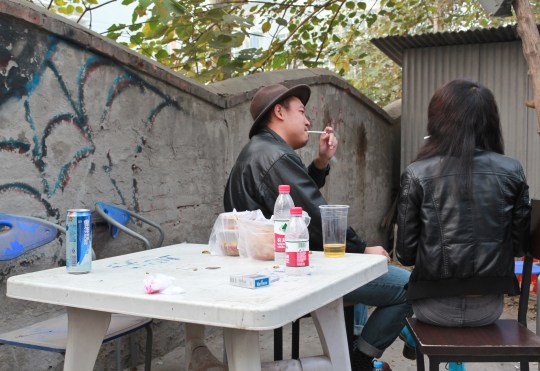
The scene before me - aside from the plethora of young Chinese punks and people smoking inside - doesn’t initially seem too unusual. A grunge bar with punk music and cheap beer isn’t exactly culturally original or specific to China. But, after several hours of conversation with various people who sat down with me at the dirty plastic tables outside the venue, there were marked differences that made the experience simultaneously remarkable and tragic.

Travelling to DMC from campus in Wudaokou involved four trains and three transfers then a taxi through a dusty village where stray dogs moved between rubbish piles. Tongzhou, in the south-east of outer Beijing, is far removed from a typical understanding of Beijing - particularly Beijing city. However, a first encounter with this area is deceiving. In the mid-1990s, artists were forced to leave the Old Summer Palace’s creative community in search for cheaper rent - a lot of them found themselves in Tongzhou. It has since grown as vital centre for artists and musicians.

DMC, located across the road from the Beijing Modern School of Music, is a punk venue seemingly made of several sheds wielded together. It is a tiny, dark space with a small bar, floor-high stage and anti-establishment posters and graffiti filling the walls. DMC’s only other room is for the squat toilet, which didn’t appear to flush.

After entering the venue with my friends, Xiao Xiao greeted Li Yang (also known as Spike) with an excited hug, then introduced me to him. Li Yang has shoulder length hair and was casually dressed in a red and black stripped long sleeve top and jeans - however, his story and drive is anything but casual. Li Yang, a vocalist for local band Demerit, along with Ying Chen built and now maintain the punk club DMC; together they have established more than just a punk venue.

DMC is a place where people, who call each other “brother” and “sister,” come together to love punk and share their rage for a government that - in their opinions - “treats its citizens like animals.” It was at this venue where we met a fifteen year old boy who spat and smoked and told us he had run away from home because he was gay. Other new friends desperately talked about plans to eventually earn enough money to leave China. There are few places in Beijing where these kinds of discussions could happen so freely and even at DMC they were taking risks.

But despite the hope and anti-establishment culture created by places like DMC, there remained a cruel reality beyond the dusty walls that enclosed it. As one young man, the same age as me, with an elvish like face and long black hair sadly told me, “when I wake up tomorrow morning, this will all seem like a dream.”

xx
Lou

Saturday, October 25

gallery or lounge?


I was looking around the lounge that I share with Jiawen (my Chinese flatmate) and had to laugh at how derelict it looked. But, on closer inspection, I realised there was something strangely captivating about its cleanliness and the dashes of colour (particularly yellow) beautifully arranged within this odd space.

xx
Lou

Friday, October 17

bedroom view


Lying in bed, coming to terms with the realisation that this was the first day nothing too random happened...then noticed extraordinarily bright flashes of light through my curtains. The midnight construction on the canteen at one of China's best universities makes me question workers’ rights here…it also makes me thankful for my sleeping mask.

xx
Lou

Sunday, October 12

strips of plastic


1/10/2014

Beyond the heavy strips of plastic that fell over the entrance’s doors (just up from the spiral staircase and security check) was a club of exhilarating scale.  It was an ecstatic world, impossible to interpret and almost impenetrable. A huge disco ball reflected laser lighting throughout the venue and house music filled the rare empty spaces between the tightly packed people. After entering a venue like that in China, I immediately wondered where to begin and how to begin. But I didn’t have to for long - it was decided for me.

Almost immediately after entering the club my friend was pulled from the crowd into a small raised area. Momentarily confused as to where she went, we found her again and she gestured for us to join her. We did so in an attempt to remove ourselves from the persistent men who had already surrounded us (apparently the presence of a female body is always an invitation).

The open booth that we stood inside had a small table with towering stands filled with fruit and glasses of Moet - as I joined the group, a glass was thrust into my hand and refilled whenever I finished it. Centered almost in front of the DJ desks where Fedde le Grand was playing, this group were very deliberately displaying their wealth. No one asked our names, no conversation was attempted (except a string of “I love you(s)” later on). And as I danced I began to feel less human and more a part of the display. I thought I had stepped into this “exclusive” area as a feminist, empowered by my actions, but soon I wondered if I was perpetuating a stereotype and submitting to a lesser status by continuing to be there.

I felt the older man beside me edge closer and noticed the tattoos snaking up his forearms as he reached for me. This wasn’t so much an intellectualised problem that presented itself, but one of safety - of protecting myself and my friends. I looked up at them - from the outset they seemed okay. If anything, the experience at that point remained more entertaining than it was threatening. Staff stood by with grotesquely large and unexplained bouquets of flowers. They were at the ready to do anything the people around us requested, which included telling people who tried to approach the group to leave. I watched my friends being fed pieces of sculptured cucumber, they were laughing so I continued to dance.

However, later, as I sat down to rest briefly the man beside me gestured for me to cross my legs as (I assume) my posture was too masculine and I wasn’t behaving my role properly. Slightly surprised, I reexamined the people around me. That’s when I noticed four young Chinese women sitting in the different corners of the booth, several looked bored and one was sulking. As I watched them, a Californian man, who had been attempting to join the group by showing photos of naked woman on his phone to one of the men, appeared beside me. He lent over and shouted in my ear that he would get free champagne if he kissed me in front of the group. At that point, I decided to extract myself from the stage and disappear.

We thanked the men for the Moet and threaded through the crowd to the other side of the packed venue, but moments later one of the men had found us and started to grab my wrist and waist attempting to pull me back. Perhaps I had misunderstood the influence (or appearance of influence) this group had over the club. Given this, I had also failed to consider how little anyone could or would do to help us if we were in trouble. With recent reports of clubs being shut down at random for mandatory drug testing of every single person inside, trouble can happen so quickly in China. And you can’t ask questions.You can’t resist. Your status as a “foreigner” offers no protection either.

Early morning and with the entertainment of the evening wearing off, we agreed to leave the club. Once outside, we weaved through picnic benches and one man on all fours vomiting into the street gutter. We hailed down a taxi and ended another night in China.

xx
Lou

Sunday, October 5

return to beneath the shadow

Illustration for my last Critic feature "Return to Beneath the Shadow" by Dan Blackball.
1) Return to Beneath the Shadow by myself! Here is my last feature for Critic this year and potentially forever. It reads as a thought diary (uh oh) of my move from New Zealand to China. As always, take a look or not! And, also, if anyone reading this can pay me money to continue to write, you'd most likely be lying or you'd be some kind of magical creature and I'd be incredibly interested.

2) Hikikomori by Kate Stewart One day, overwrought with pressure from his school and family, Haruki shut himself in his shoebox-sized room, severed all contact with the outside world, and did not emerge for nine years. His only human interaction was mediated through the Internet. He spent month after month sleeping all day and slouching in front of a computer at night, devoting the majority of his time to searching the web, playing video games and anime.

3) The Mapuche: The People of the Land and Their Struggle to Retain It by Bella Macdonald Sharing their home with a six billion dollar timber industry, the Mapuche people of Aracaunia are the poorest in Chile. After centuries of land wars and inequality, the Mapuches, meaning “people of the land,” are beginning to break the silence, uniting to fight to get their land back and get the same rights and privileges as non-Mapuches.

xx
Lou

Thursday, October 2

navigating difference in beijing

Above are photos I took from my room on the 6th floor of Building 19 on Tsinghua's campus. I have since moved across campus to a very new building where I share a lounge and a bathroom with a Chinese student called "Candy."
Navigating cultural differences on the Tsinghua campus and around Beijing is something I never actively considered before coming here, but - instantly - on arrival in China’s capital it has proved to be something I must consistently think about it.

As a white, western (young) woman maybe I didn’t think about this because of a deep and naive affinity to my own privilege. In New Zealand, I never truly stood out and could, on the whole, be part of the crowd and hide within it. I also am part of a socio-economic class that afforded me more control and freedoms. If I felt drawn to “a cause” (political or social), I could unquestionably find a group to be a part of or I could freely write about it through any medium. Although I am often anxious and over-analytical, in New Zealand I had a relatively straightforward identity. I had freedoms. I had a voice. I had a hopeless attachment to the myth of the individual.

And as much as I could, I tried to be aware of my freedoms and, simultaneously, be aware of what I still could not have as a female (like control of how my body is perceived, compartmentalised and commodified by different parts of society). However, daily life in China has both forced me to adopt an outsider status, temporarily restricted certain liberties (for example, we were explicitly warned that organising any type of religious gathering on campus is a punishable offence) and exaggerated what I could not have as a woman.

Without wanting to victimise myself and appear to lament for these new statuses, I have been trying to put together different pieces of these realisations, but I still have a puzzle in front of me rather than an idea of what the end picture could look like. I really am not the heroic lone male traveller like Kerouac’s Sal Paradise or Twain’s Huckleberry Finn, who we so readily allow a “great” story and our enduring adoration. Instead, I am an anonymous female who has to write to create a narrative and therefore protect myself (thanks Adrian for that link to Vanessa Veselka’s wonderful essay).

I am currently working out whether to use this blog as a space to put things together as well as share my experiences of Beijing. So, for now, perhaps consider this a pre-post announcing more musings to come?

xx
Lou

Thursday, August 14

the subconscious restaurant


SUBCONSCIOUS RESTAURANT
BEIJING LAUNCH EVENT
AUG  16 (SAT)
@ ZAJIA LAB
START TIME: 20:00
ENTRY: 50RMB

On August 16th is the launch event of White Fungus' experimental music magazine in Beijing. I am not there int time for it but it'll be great fun. Hearing about events like this get me so excited for the move!

xx
Lou

Saturday, May 14

two things tuesday: india travel diaries 7

I know it's not Tuesday.


The glorious bangle store we went to following the I Love Rajasthan guide book. Liz Hurley bought her wedding bangles here. Out the back were little old woman carefully sculpting and painting these wonderful things. What's best of all is that the store is so discrete which allows you to simply enjoy the humble ambiance of tradition and craftspeopleship.


A photo from another crafts workshop we went to. I thought this place however was much more commercialised and less elaborate. The print you see involves several different stamps with different colours. Later, they repeat the pattern over and over again which makes a patterned blanket/material.

On a third and unexpected note I have another film from Chinese film class that had a small element of indianess in it, 'Chungking Express'. It's very ambiguous and had a fabulous reception. What's most important is that I went to a vintage store in India that may have sold the set props for this film's misenscene! How bizarre.


Also, you MUST watch a Hou Xiaoxian film in your lifetime. THE Taiwanese director. No doubt I will blog about him to a much more in depth extent but for now, here's a film trailer:


xx
Lou

Wednesday, February 3

how's china?

Consumed by China (zhong guo)


ke ai! (cute)
My future career.
Our incredible taichi/gong fu (kung fu) master...who made us run two laps around the field and then do strenuous exercises to warm up...


Chinese style.

This is the flower selling grandmother daughter duo in action...hilarious but worrying.

One of the gorgeous entrances to the underground market.


City view of Chongqing...known for it's fog.

Look at these magnificent women, a totally unique breed.
This is the look of self-satisfaction.

"i love you" apples, isn't that sweet!


oh boredom...


it was so dry in Beijing that our hair went wild child.

Isn't this the water cube?


There are pandas everywhere in China, you can even find them marching up and down the great wall.

Fantastic traditional clothing. how exciting would life be if people wore this on a daily basis.
the glorious tea from Lao She Tea House, Beijing. we drank this and watched a hilarious and very Chinese cultural performance.


I wonder what you can buy at a shop called Mini Wart?
Check out those gorgeous shoes.
First view of Beijing.